
How do you get good at something?
Simple question. The kind you can scribble on a sticky note or whisper dramatically into the mirror like you’re preparing for a TED Talk. And the answer is usually packaged neatly too: “You just do it. Often.”
Plain and simple, right?
Probably not.
If life has taught me anything, it’s that “simple” and “easy” aren’t siblings ,they aren’t even distant cousins. Doing something often does help, sure, but doing it with intention is what moves the needle. You need consistency and clarity. Repetition and refinement. Discipline and direction.
I didn’t learn that from a self-help book or a paid webinar with a guy wearing a headset microphone. I learned it from chess. Or rather…I learned it from failing at chess.
My First Chess Lesson… Sort Of
My father taught me chess ,well, “taught” is perhaps a generous description. My sister and I learned how all the pieces move, what each one is called, and why the knight insists on moving like it’s avoiding potholes on purpose. Then came the moment of truth: our first match against each other.
It started off cute. Quiet. Almost respectful.
We moved our pawns one square at a time, like they were elderly citizens crossing the street. A pawn here. A pawn there. And then we froze.
We were stuck. Not because the game was complicated but because neither of us wanted to capture each other’s piece. We tiptoed around the board like we were scared of hurting each other’s feelings. My father, watching this circus, finally burst out . “I’ve never seen two people so scared of taking pieces,” he said, shaking his head.
Eventually, my sister did it she ate one of my pawns. My beloved pawn. My emotional support pawn. And I… lost it.
We didn’t finish the game.
What a loser, I know.
And that was the end of my early chess career.
25 Years Later: The Rematch
Fast-forward 25 years. I found myself sitting across from a new opponent: a CPU. A cold, calculating, unbothered machine that didn’t care about my feelings, my childhood traumas, or my emotional support pawns.
And this machine punished me ruthlessly.
Again.
And again.
And again.
Every mistake. Every slow idea. Every hopeful move that I thought was genius—met with instant consequences. But something in me refused to give up. So I made a decision:
I would play at least three games every single day.
Rain or shine.
Tired or fresh.
Busy or free.
No negotiations. No “I’ll do it later.” No “just one YouTube video first.”
Three games. Daily.
And to level up, I set a rule:
I could only advance to the next difficulty once I’d won three games in a row.
Not three games overall.
Three. In. A. Row.
Spoiler:
I could not do it.
I played for two weeks, two full weeks, before I even managed to win two games back-to-back. Remember, the target was three. You’d think knowing the rules would help, but nope, not a chance. The computer reminded me daily that “knowing” and “doing” are very different things.
Where Discipline Meets Deliberate Practice
Eventually, I hit a wall. A very stubborn wall. I realized that playing three games every day was good discipline, but discipline alone was not going to win me three games in a row.
I had to figure out what was actually going wrong.
Where was I consistently losing the plot?
Was I giving away pieces for free?
Attacking without thinking?
Missing simple threats?
I needed to know what to improve before I could improve.
Once I started studying my mistakes intentionally, checking my blunders, reviewing my openings, noticing patterns, I finally won the third game in a row.
And just like that, I moved from “Easy” to “Medium.”
That jump didn’t come from discipline alone. It came from a system.
A rhythm.
A process.
A combination of consistent effort and targeted improvement.
And honestly… that feels like most things in life.
Discipline Isn’t Just a Habit, It’s a System
People often talk about discipline like it’s a personality trait. Like you’re either “a disciplined person” or you’re not. But I think that misses the point completely.
Discipline is not a mood.
It’s not motivation.
It’s not willpower over everything.
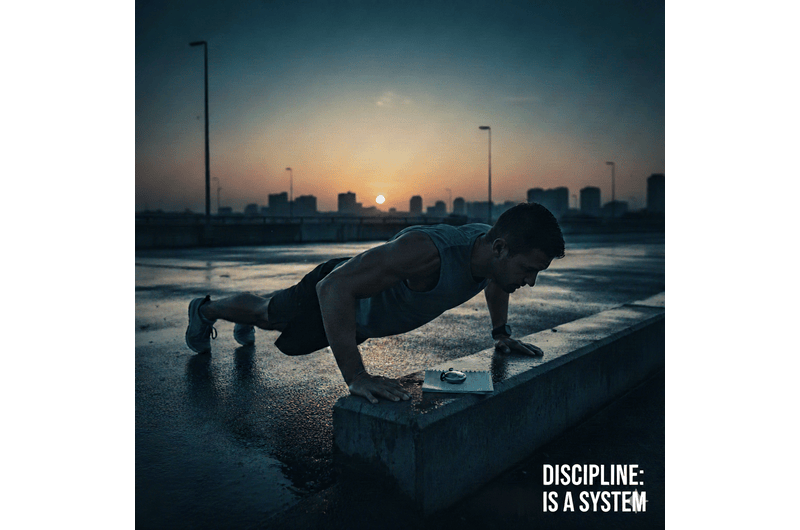
Discipline is a system.
A structure you build around your goals.
A routine you design to make success the default, not the exception.
A way of removing decision-fatigue so the only thing left… is the doing.
It’s not just waking up early.
It’s why you wake up early.
It’s what you do once you’re awake.
It’s knowing exactly what needs work, what needs repetition, and what needs to be changed.
Discipline is doing the thing, every day, but also knowing what to do differently as you go.
Because consistency without learning is repetition.
But consistency + learning?
That’s growth.
The Hidden Enemy of Discipline: Options
Now, let’s talk about the villain in this story: options.
We love options. Options make us feel smart and powerful and independent. But when it comes to discipline, options are the cracks in the foundation.
“Should I go to the gym today… or tomorrow?”
“Should I write now… or after I rest for a bit?”
“Maybe I’ll skip just this once.”
“I’ll start again on Monday.”
That little moment where you negotiate with yourself?
That’s where discipline goes to die.
Options aren’t freedom, they’re a trap.
A beautiful, comfortable, seductive trap.
That’s why systems work.
A system removes unnecessary choices.
You don’t wake up and decide whether you’re doing your three games today.
You just do them.
Rain or shine.
Motivated or unmotivated.
Winning or losing.
You build a system so strong that it carries you through the days you don’t feel like showing up. Because those days will come. They always do.
What a System Actually Looks Like
A system isn’t complicated. It’s not a 10-step ritual with candles and inspirational playlists (although do you, if that helps).
A system is simply:
1. A clear rule you follow daily
“Three games a day.”
“Write for 20 minutes.”
“Practice public speaking for 15 minutes.”
Whatever your thing is.
2. A way to evaluate what’s working and what isn’t
Review your mistakes.
Identify your weaknesses.
Spot patterns.
3. A commitment to adjust as you learn
There’s no point in being consistent at the wrong thing.
4. Removing unnecessary choices
Don’t negotiate with your goals.
Negotiate with your restaurant bill.
Negotiate with your data bundle.
But not your goals.
A system is simply a promise you make to yourself, supported by structure rather than emotion.
Life Is the Same Game Played Over and Over
The more I think about it, the more I realize that most things in life work the same way chess works.
You show up.
You play the game.
You make mistakes.
You learn.
You adjust.
You try again.
You try again.
You try again.
Some days you win because you did everything right.
Some days you win by accident.
Some days you lose and don’t know why.
Some days you lose and know exactly why, and that’s even worse.
But if you keep showing up and keep learning, you get better. Not magically. Not suddenly. But steadily.
And that’s what discipline really is. Not a rigid, joyless grind. Not perfection. Just a simple system that nudges you forward every day.
Final Thought
The truth is, we all like the idea of discipline more than the actual doing of discipline. But when you treat discipline as a system, not an emotion, you give yourself the best chance of succeeding at anything.
Set the rule.
Remove the choices.
Show up.
Improve as you go.
Everything else is noise.